✨ Verified 2026/27 Tax Thresholds · Audited across 22 Official Government Revenue Databases

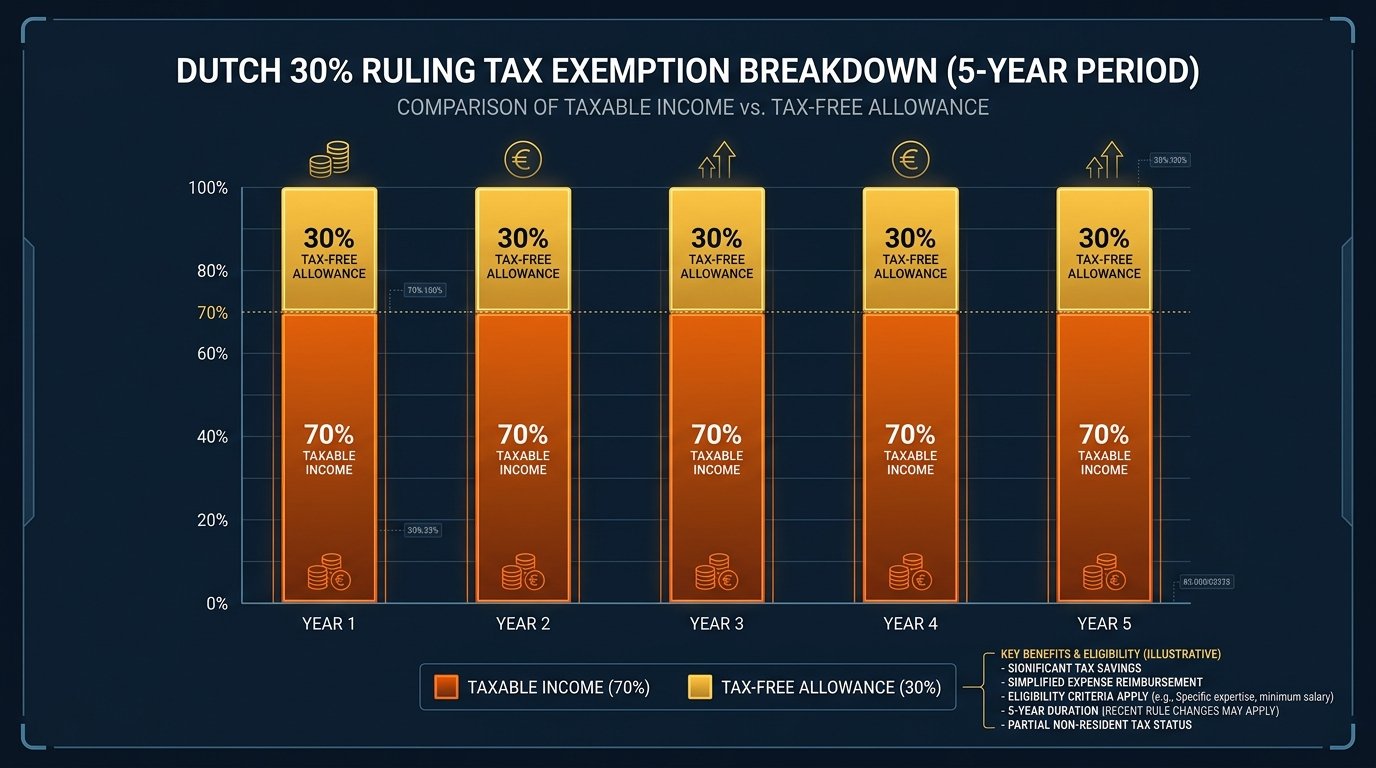
For qualifying expat professionals, the 30% ruling is the most generous tax break available in the Netherlands — potentially adding €900/month to take-home pay in the first few years. But the reform that came into effect in 2024 has changed the maths considerably.
The Dutch 30% ruling (30%-regeling or expatregeling) allows employers to pay a tax-free allowance of 30% of gross salary to employees who are recruited from abroad and meet specific criteria. The idea is to compensate for the "extraterritorial costs" of relocating — things like double housing, international schooling, and the general disruption of moving country. In practice, it functions as a substantial tax reduction that makes the Netherlands significantly more competitive for international talent than its headline tax rates suggest.
The key change from 2024 is that the ruling no longer applies at a flat 30% for the full duration. It now phases down over 60 months. That reform was controversial — and still is, because it affects anyone who received approval for the ruling after 1 January 2024.
If you qualify, your employer can designate 30% of your gross salary as a tax-free reimbursement for extraterritorial costs. That portion is not subject to Dutch income tax or social premiums. The remaining 70% is taxed normally under Box 1 (employment income).
On a €85,000 salary, this means your taxable income becomes €59,500 rather than €85,000. Dutch Box 1 rates are 36.97% on income up to €75,518 and 49.50% above that, so the difference in taxable base creates a substantial tax saving.
Under the old system (pre-2024 approvals), you received 30% for up to 60 months. Under the new system:
The total benefit still runs for 5 years, but it's front-loaded. The first two years are the most valuable; by year four and five, the advantage has narrowed considerably.
The core requirements for 2026:
The difference in monthly take-home across the three phases of the ruling, compared to having no ruling at all, for a single person earning €85,000 gross:
The Phase 1 advantage is €958/month compared to having no ruling. By Phase 3, that has narrowed to €295/month. Over the full 60 months, the total tax saving is roughly €43,000 on an €85,000 salary — still substantial, but considerably less than the old system's 5-year flat 30% would have yielded.
Yes — and this is where careful planning matters. Even with 30% ruling status, you remain eligible for:
The partial non-residency option was introduced specifically for 30% ruling holders and can add meaningful value for those with overseas assets — though it requires filing carefully to avoid double-counting in both jurisdictions.
The 30% ruling isn't free. You must apply formally through your employer using the Dutch Tax Authority (Belastingdienst) form, and the application needs to include documentation of your prior residence, qualifications, and employment terms. Approval typically takes 8–16 weeks.
If your salary is just above the €65,867 minimum, the absolute gain may not justify the complexity — particularly if your assignment in the Netherlands is likely to be shorter than 2 years, in which case you'd only benefit from Phase 1. The calculation tilts strongly in your favour at higher salaries: a €130,000 earner in Phase 1 saves around €1,400/month. At that level, the administration is straightforwardly worthwhile.
One scenario where people consistently miscalculate: if you received the ruling while employed at Company A and you change to Company B, your ruling transfers — but the clock doesn't reset. The 60-month total continues from when the original ruling was granted. If you're 30 months into the ruling when you change jobs, you have 30 months left, not 60.
See your exact Dutch take-home with and without the 30% ruling applied using our Netherlands Salary Calculator.
Need custom deductions, pension contributions, or local tax calculations?
Open Interactive Calculator →Subscribe for annual tax bracket changes, expat guides, and salary insights across 22 countries.