✨ Verified 2026/27 Tax Thresholds · Audited across 22 Official Government Revenue Databases

Singapore's income tax tops out at 24%. The UK's hits 45% before you factor in National Insurance. For mid-to-high earners, the difference in monthly take-home can be extraordinary — but the full picture is more nuanced than the headline rates suggest.
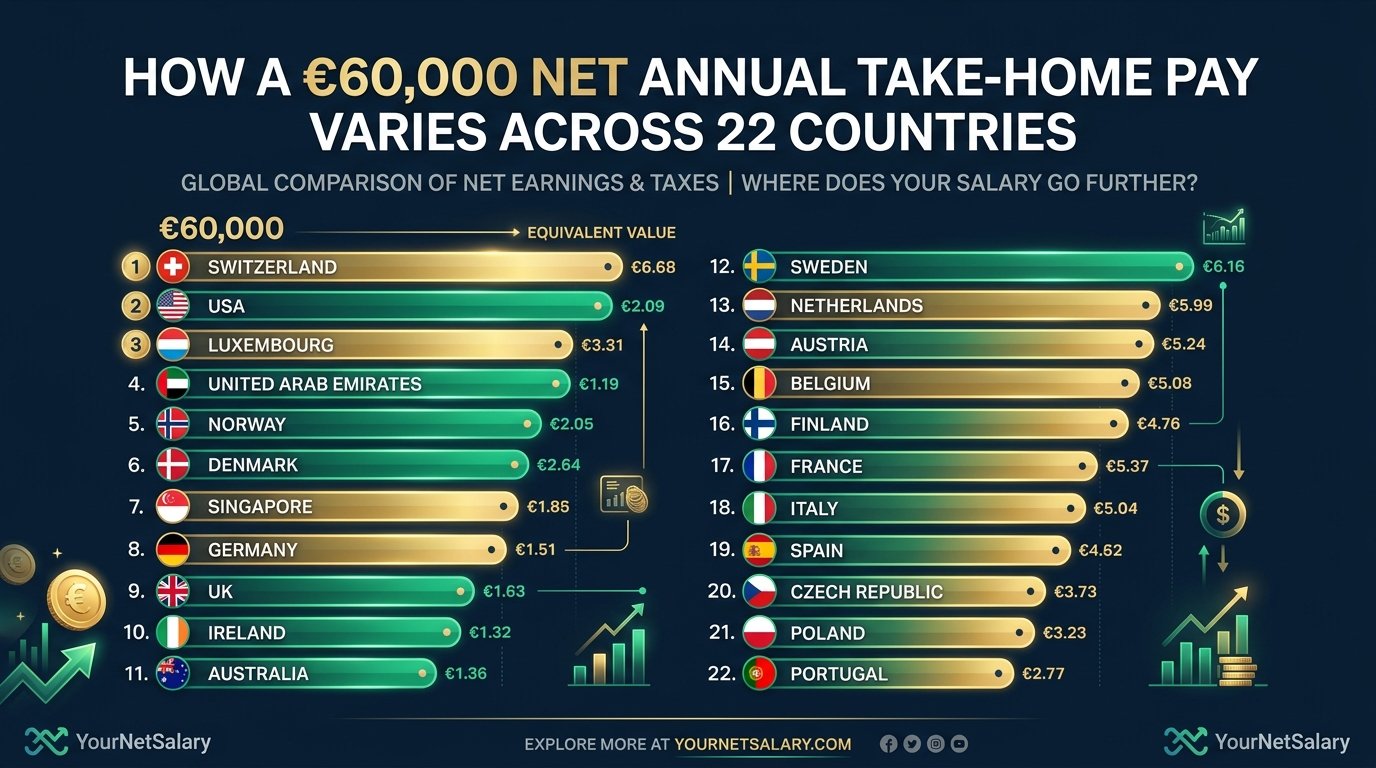
Singapore's top income tax rate is 24%, applying on income above S$320,000. Below that, rates are much lower — Singapore taxes aggressively at the bottom of the income distribution (for residents) but takes a gentle approach with high earners. There's no capital gains tax, no inheritance tax, and no wealth tax.
The UK's top rate is 45%, hitting income above £125,140 after the personal allowance is fully withdrawn. On top of that, National Insurance at 2% applies on all earnings above £50,270. And between £100,000 and £125,140, there's the 60% effective rate from the personal allowance taper.
But comparing "24% vs 45%" misses something important: Singapore workers pay CPF (Central Provident Fund) contributions at a rate that can seem high but serves a very different purpose than taxation.
CPF is not a tax — though it functions like one. Employees under 55 contribute 20% of ordinary wages to CPF (up to a monthly wage ceiling of S$7,400). Employers contribute another 17.5%. The combined contribution can exceed 37% of salary.
Unlike UK tax or Germany's social contributions, your CPF funds go into your own three accounts: Ordinary Account (housing, education, investment), Special Account (retirement), and Medisave (healthcare). You own these funds and can use them for approved purposes. At 55, you can withdraw everything above the required retirement sum.
CPF is technically your money. Tax is not. This is a crucial distinction when comparing Singapore and UK take-home pay.
Let's take a financial professional earning in the S$120,000–S$200,000 range — a common bracket for mid-to-senior finance and tech professionals in both cities.
| Salary | 🇸🇬 Singapore Monthly Net (after income tax only) | 🇬🇧 UK Monthly Net (after tax + NI) |
|---|---|---|
| S$120,000 / £80,000 | S$9,620/mo | £4,656/mo |
| S$180,000 / £120,000 | S$14,120/mo | £6,978/mo |
| S$250,000 / £165,000 | S$19,250/mo | £8,650/mo |
The Singapore figures use income tax only (not CPF), because CPF remains your own money. But even in direct cash terms, Singapore professionals keep dramatically more.
On a S$250,000 / £165,000 salary (similar purchasing power bracket), the Singapore professional's monthly tax-only deduction is roughly S$5,750 (27.6% effective rate). The UK professional's income tax + NI total deduction is approximately £5,500 (40% effective rate). In cash terms, the gap is roughly S$4,000–5,000/month in favour of Singapore.
Nothing is entirely free. Singapore's lower taxes mean: no universal NHS equivalent (your Medisave CPF account covers hospitalisation costs; private insurance covers the gap), shorter social safety net for unemployment (a specific severance framework exists but it's not comparable to UK benefits), and no state pension equivalent funded by others. Your CPF is your retirement fund.
For young, healthy professionals who don't expect to use NHS services heavily and are disciplined savers, Singapore's model is financially superior on almost every metric. For those with chronic health conditions, dependents, or less certainty about retirement savings behaviour, the UK's universality has genuine value.
Singapore's tax advantage is partially offset by housing costs. A two-bedroom apartment in a central district rents for S$4,500–S$7,000/month. A comparable apartment in London might cost £2,800–£4,500/month.
After adjusting for Singapore's higher rental costs, the disposable income advantage narrows — but doesn't disappear. A financial professional in Singapore on S$200,000 might pay S$5,500/month rent, leaving S$9,000+ after tax and rent. An equivalent in London on £140,000 might pay £3,500/month rent, leaving £5,000 after tax and rent. The disposable income gap is still roughly 75–80% in Singapore's favour at this income level.
The calculation increasingly favours Singapore for: finance professionals above S$150,000 salary, tech roles at regional or global companies based in Singapore, and any professional planning to stay for 5+ years and accumulate significant CPF savings. The CPF balance can be substantial after 10 years of high-income working — at S$200,000/year, you're accumulating S$40,000+/year in CPF in addition to your take-home cash.
The UK remains preferable for: those who value NHS access without private health insurance costs, those with strong ties to the UK's social infrastructure, and lower-income workers where Singapore's absolute cost of living makes the tax advantage largely irrelevant.
Calculate your Singapore take-home: Singapore Salary Calculator · UK Salary Calculator
Try the interactive tool: Singapore vs UK take-home pay comparison →
Related: Germany vs UK take-home comparison · Belgium's extreme tax burden
Need custom deductions, pension contributions, or local tax calculations?
Open Interactive Calculator →Subscribe for annual tax bracket changes, expat guides, and salary insights across 22 countries.