✨ Verified 2026/27 Tax Thresholds · Audited across 22 Official Government Revenue Databases

Ask a room of expats which country leaves more in your pocket and you'll get two confident, opposite answers. The truth embarrasses both camps: through the heart of the professional salary range, France and Germany land within a few dozen euros of each other — and the country that wins flips at almost exactly €70,000.
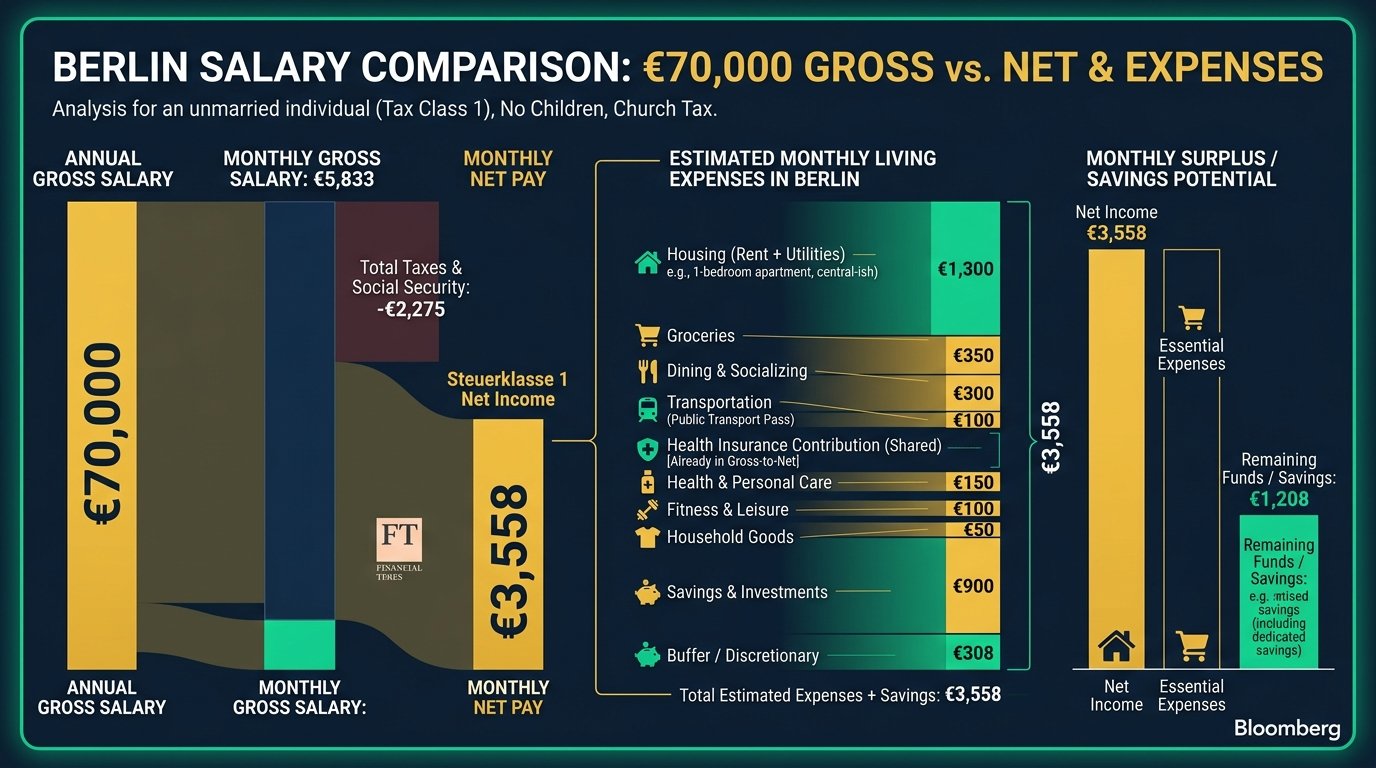
When the OECD publishes tax wedge comparisons, France and Germany sit near the top of Europe for labour costs. But the tax wedge includes employer contributions, which never appear in anyone's payslip. What matters to an employee is the gross-to-net calculation — and on that measure, the two systems turn out to be structural mirror images that arrive at nearly the same place by different routes.
The finding in one sentence: France edges ahead below roughly €70,000 gross; Germany pulls ahead above it, and keeps widening its lead. Neither margin is dramatic until six figures, but the direction surprises almost everyone — including plenty of people who've worked in both countries.
Germany doesn't tax your gross. Before the Lohnsteuer brackets apply, your social insurance contributions — roughly 21% of gross for pension, health, unemployment and long-term care — are deducted from the tax base, along with the €1,230 Werbungskostenpauschale and the €12,096 Grundfreibetrag. A €80,000 German salary is taxed as if it were about €63,400. The much-feared 42% band, which starts around €68,430 of taxable income, therefore only just grazes an €80,000 earner.
France runs the sheltering the other way around. Income tax applies after a flat 10% professional expense deduction, so €80,000 is taxed as €72,000 — a larger base than Germany's — but through a friendlier barème: 30% covers the wide middle, and the 41% band waits until about €84,000 of taxable income. What France doesn't shelter is the social side: employee contributions of roughly 22% apply to every euro of gross, with no ceiling relevant to employees in this range.
Run the numbers and the income tax bills nearly reconcile: on €80,000, Germany's Lohnsteuer comes to about €16,100 and France's impôt sur le revenu to about €14,800. The contest is decided almost entirely by what happens to social contributions above the German ceilings — which is exactly where the crossover comes from.
Both columns use the single-worker baseline: célibataire with one fiscal part and no special credits in France, Steuerklasse I without church tax in Germany. These are the comparable apples-to-apples scenarios; marriage and children move both systems, France through the quotient familial and Germany through Steuerklassen and the Kinderfreibetrag.
Notice how small the middle-range margins are. At €45,000 the French advantage buys a nice dinner; at €80,000 the German advantage buys the same dinner in the other direction. Anyone choosing between Lyon and Frankfurt on take-home alone at these levels is choosing on noise. At €120,000, though, the German lead is real money — over €6,000 a year.
German health and long-term care contributions stop at the Beitragsbemessungsgrenze of €66,150; pension and unemployment contributions stop at €90,600. Every euro a German earns above those lines pays income tax only — the effective marginal rate actually falls as you pass €66,150. France has no employee-side equivalent: the ~22% social layer rides every euro, all the way up, and the 41% and 45% income tax bands stack on top later.
That single structural difference explains the entire high-end divergence — and why the old expat wisdom that "France pays better net" is precisely backwards for senior engineers, doctors and managers. It was last reliably true in the range where most people first compare the two countries: early-career salaries.
Calculate your exact take-home in France or Germany using our salary calculators — including all social contributions and income tax.
Try the interactive tool: France vs Germany take-home pay comparison →
Related: €50,000 after tax in France · €70,000 after tax in Germany · Germany vs UK take-home pay · Belgium's 52.7% tax wedge
Need custom deductions, pension contributions, or local tax calculations?
Open Interactive Calculator →Subscribe for annual tax bracket changes, expat guides, and salary insights across 22 countries.